Signs of Avoidant Attachment in a Partner: Recognising the Subconscious Push-Pull

What if your partner’s sudden withdrawal isn't a rejection of your worth, but a primitive shield against the very intimacy they crave? You know the sensation well. One moment you are close; the next, you are met with a wall of silence or a chilling emotional distance. Recognising the signs of avoidant attachment in a partner is the first step toward reclaiming your energetic sovereignty. It is exhausting to live in the "hot and cold" cycle whilst constantly questioning your own value. You feel lonely, confused, and desperate to fix a fracture you did not create.
These behaviours are calculated, subconscious, and protective. They are survival mechanisms forged in the shadow. We will peel back the layers of the push-pull dynamic to reveal the hidden drivers of their distance. You will learn to stop the cycle of self-sabotage, realign your internal state, and navigate this relationship from a place of unshakeable authority. It is time to stop chasing and start commanding a secure, magnetic connection. This is the path to clarity, strength, and transformation.
Key Takeaways
- Decode the subconscious architecture that transforms intimacy into a perceived threat. Understand that withdrawal is a strategic move to protect, shield, and distance.
- Recognise the definitive signs of avoidant attachment in a partner, such as "future-phobia" and the tactical use of idealised exes to block current closeness.
- Shift from the draining urge to "fix" the dynamic to a state of radical self-focus. Reclaim your power, your peace, and your sovereignty.
- Define your non-negotiables for emotional safety. Stop settling for crumbs and start establishing a standard that commands respect and consistency.
- Move beyond surface-level communication into deep subconscious reprogramming. Use The Magnetic Recalibration to shift your energy from survival to magnetism.
Beyond "Playing Hard to Get": Defining Avoidant Attachment
Avoidant attachment is not a personality quirk. It is not a conscious choice to be difficult. It is a survival-driven subconscious strategy designed to maintain safety by strictly limiting intimacy. Whilst many mistake this behaviour for a simple desire to "play hard to get," the reality is far more clinical and visceral. This is a chronic pattern of Attachment in adults that dictates how an individual perceives, processes, and rejects connection. Unlike temporary withdrawal caused by a heavy workload or family stress, this is a baseline energetic state. It is a rigid internal architecture built to keep the world at arm's length.
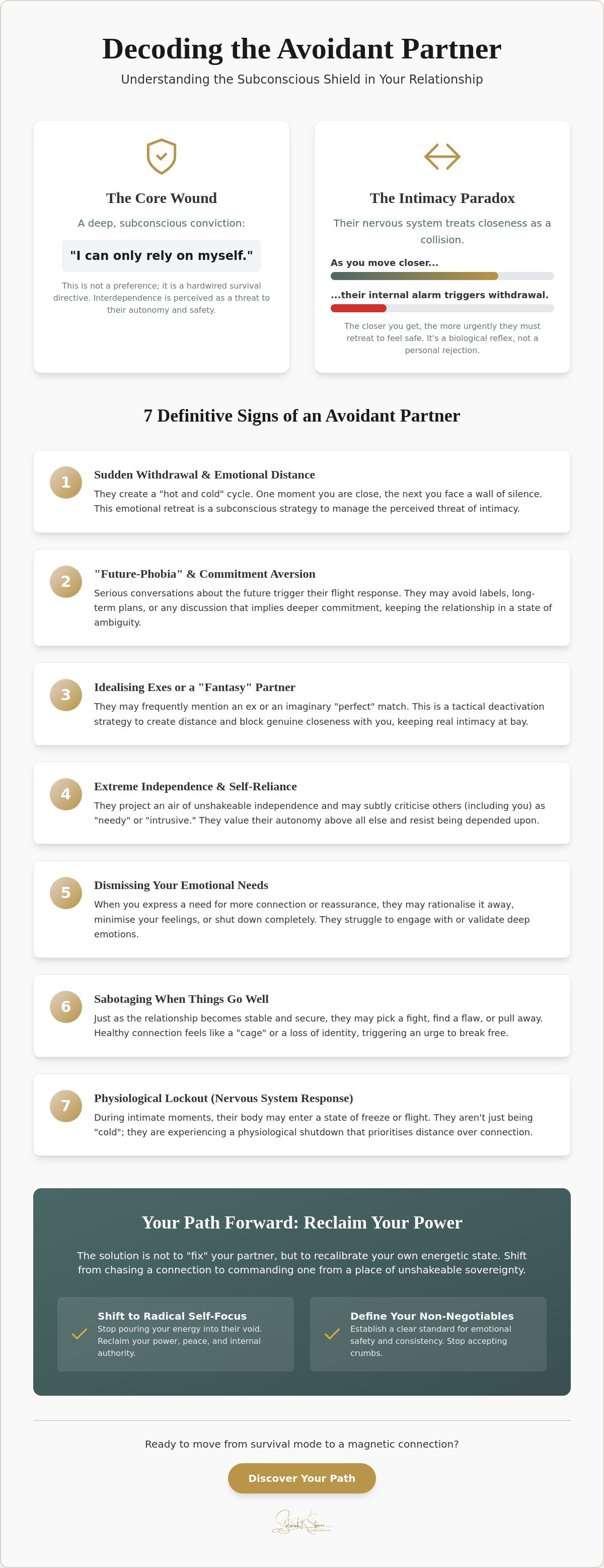
Here lies the intimacy paradox: the closer you get, the more they must retreat. It is a biological reflex. When emotional depth increases, their internal alarm system triggers what psychologists call a "deactivation strategy." They shut down, pull back, and disconnect. They aren't trying to hurt you; they are trying to survive the perceived threat of being known. Recognising the signs of avoidant attachment in a partner requires you to look past the surface silence to see the internal panic beneath. It is an energetic wall designed to protect, shield, and distance.
The Spectrum of Emotional Unavailability
Not all avoidance is built the same. Dismissive-avoidants often project an air of unshakeable independence, viewing others as needy or intrusive. They value self-reliance above all else. Fearful-avoidants, or those with a disorganised style, exist in a state of constant internal collision. They crave the very connection that absolutely terrifies them. In early dating, this might manifest as intense charm and magnetism. However, as commitment looms, they often retreat into a "fantasy bond." They might idealise a past partner or an imaginary future "perfect" match to avoid the messy, vulnerable reality of the person standing right in front of them.
Why Closeness Feels Like a Collision
To an avoidant, intimacy does not feel like a warm embrace. It feels like an invasion. It is a smash. A collision. A total loss of self. Their subconscious links vulnerability directly to a loss of autonomy. When you ask for more, their nervous system does not hear a request for love. It hears a threat to their survival. This triggers an immediate shift into freeze or flight. They aren't being "cold." They are experiencing a physiological lockout that prioritises distance over depth. To navigate this, you must understand that their retreat is a nervous system response, not a reflection of your worth.
The Subconscious Architecture: Why They Pull Away
The internal world of an avoidant is not a void. It is a fortress. At the very centre of this structure lies a singular, jagged Core Wound: the absolute conviction that "I can only rely on myself." This is not an opinion. It is a survival directive. When you see the signs of avoidant attachment in a partner, you are witnessing a nervous system that has been hardwired to view interdependence as a fatal flaw. They don't just prefer independence; they require it to feel alive. This is the bedrock of an Avoidant Attachment Style, where every move toward closeness is met with a subconscious counter-move toward isolation.
Shadow Work and the Fear of Enmeshment
In the shadow of the avoidant psyche lives a profound fear of being consumed. They perceive enmeshment as a total loss of identity. It is an energetic suffocation. When a relationship begins to feel "good on paper," the avoidant often experiences a sudden, violent urge to sabotage. The more stable the connection becomes, the more they feel the need to break, scatter, and realign their boundaries. They use distance to re-centre themselves. They retreat to find the air they feel you are stealing. This is why healthy, secure love often triggers the loudest alarms. It feels like a cage. It feels like a collision. It feels like an ending.
The Nervous System in Survival Mode
When intimacy deepens, the avoidant partner enters a physiological lockout. Their heart rate spikes. Their muscles tighten. Their breath shallows. They are in a state of high-stakes survival. Trying to "talk it out" at this stage is a tactical error. It increases the pressure. It demands more of the very thing they are currently fleeing: emotional vulnerability. This is where somatic awareness becomes critical. You must learn to recognise the physical shifts before the emotional wall goes up. If you don't, you will find yourself talking to a shadow whilst the person has already checked out.
Lasting change cannot be found in surface-level communication or "trying harder." It requires a surgical approach to the subconscious. Willpower is useless against a nervous system that is convinced it is under attack. Shifting these deeply ingrained patterns requires a total energetic realignment. If you are ready to stop the cycle of self-sabotage and move toward a magnetic connection, exploring The Magnetic Recalibration can provide the structural shift needed to heal. Subconscious reprogramming is the only way to dismantle the fortress and replace it with a bridge. It is about moving from a state of collision to a state of flow. You must break, shift, and realign to truly connect.
7 Definitive Signs of Avoidant Attachment in a Partner
Identifying the signs of avoidant attachment in a partner requires more than a surface-level observation of their behaviour. You must look for the energetic patterns of withdrawal. These aren't random acts of distance; they are tactical, subconscious moves designed to keep you at bay. When you understand these markers, the confusion of the "hot and cold" cycle begins to dissolve. You stop blaming yourself and start seeing the architecture of their fear. Here are the definitive indicators that your partner is operating from an avoidant blueprint.
- The "Future-Phobia": Watch for vague, non-committal responses to long-term plans. Whether it is a holiday next year or a commitment milestone, they refuse to anchor themselves to a shared future. It is a refusal to lock the door to their exit.
- The "Idealised Ex": They hold onto a ghost. By putting a past relationship on a pedestal, they ensure no one in the present can ever reach that height. It is a defensive barrier disguised as nostalgia.
- The "Nit-Picker": They weaponise minor flaws. They focus on trivialities, your habits, or small personality quirks to justify the emotional chasm they are creating. It is a search for reasons to leave.
- The "Solitary Crisis": When life gets hard, they vanish. They don't seek support; they seek isolation. They process stress in a vacuum, effectively locking you out of their internal world.
- The "Independence Obsession": They frequently use words like "freedom," "smothered," or "clingy." They treat intimacy like an attack on their sovereignty. They prioritise their isolation over your connection.
Subtle Red Flags in Communication
Communication is the primary battlefield for the avoidant partner. Watch for the "Delayed Response." This is a subconscious recalibration of power. By making you wait for a text or call, they regain a sense of control over the pace of the relationship. They prefer surface-level sharing, avoiding any discussion of deep trauma, heavy emotion, or future desires. If the conversation becomes too real, they deploy the "Joke Shield." Sarcasm and humour become weapons to deflect the weight of true vulnerability. They laugh to keep the connection shallow.
The Physical and Energetic Retreat
You can feel the wall. It is a visceral, energetic barrier that goes up even whilst you are sitting side-by-side. This often follows a period of intense closeness or sexual intimacy. The "Hot and Cold" cycle is their way of resetting the safety dial. After a moment of deep connection, they must freeze to survive. They withdraw physical affection to reclaim their boundaries. It is a silent strike against intimacy. Recognising these signs of avoidant attachment in a partner allows you to stop the chase and start your own recalibration. You see the wall for what it is: a shield, not a rejection.
Navigating the Void: How to Stop Breaking Your Own Heart
Once you have decoded the signs of avoidant attachment in a partner, the immediate impulse is often to lean in. To fix. To heal. To save. Stop. This is the moment you must shift your focus from their fortress to your own sovereignty. Reclaiming your personal power is the only way to break the cycle of self-betrayal. You are not a rehabilitation centre for a wounded nervous system. You are a sovereign being. If you continue to pour your energy into a bottomless pit of withdrawal, you will only find yourself depleted, resentful, and lost.
Recognise your role in the "Anxious-Avoidant Trap." This dynamic is a magnetic collision of two subconscious mirrors. If they represent the distance, you represent the chase. Ask yourself why you are attracted to this emotional famine. Why does their withdrawal feel like a challenge to be won? Practice "Detached Compassion." You can understand their wound without making it your life's work to suture it. You must establish "Non-Negotiables." These are the structural, unshakeable requirements for emotional safety that you refuse to compromise on. If the minimum standard of consistency, honesty, and effort isn't met, the connection is not viable. It is that simple.
Breaking the Situationship Trap
Avoidants thrive in the grey. They love the "situationship" because it offers the illusion of connection without the weight of commitment. Break this trap by initiating a radical Identity Shift. See yourself as a person who only accepts available, consistent, and visible love. You stop self-sabotage the moment you refuse to chase the unavailable. You must decide that your energy is too precious to be spent on someone who only offers crumbs whilst you are providing a feast.
The Power of the Pause
Giving space is not a loss. It is a strategic withdrawal. It allows their nervous system to regulate whilst giving you the room to perform your own shadow work. Use this time for energetic alignment. Build self-trust in the silence. You must learn to sit in the uncertainty without trying to control the outcome. When you stop the frantic pursuit, you reclaim your magnetism. If you are ready to stop being the one who does all the emotional heavy lifting, One to one Coaching can help you realign your energy and command the respect you deserve.
From Survival Mode to Magnetic Connection: The Path Forward
Willpower is a blunt instrument. It is often the first tool we reach for when trying to fix a relationship, yet it is the least effective. You cannot think your way out of a nervous system response. You cannot negotiate with a subconscious shield. Once you have identified the signs of avoidant attachment in a partner, you must accept that surface-level changes are temporary. Lasting transformation requires a total systemic overhaul. It requires shifting from a state of reactive survival into a frequency of magnetic connection. This is where the work moves from the mind to the core.
A secure relationship is not the absence of conflict. It is the presence of safety, transparency, and consistency. It is a space where vulnerability is met with strength rather than withdrawal. To reach this state, you must stop settling for the crumbs of emotional unavailability. You must decide that you are worthy of a connection that is grounded, unshakeable, and visible. This is about manifesting a "King/Queen" frequency. It is about commanding a love that matches your own depth. When you realign your internal state, you stop attracting mirrors of your own wounds and start attracting partners who are ready to stand in the light with you.
Subconscious Reprogramming for Relationship Success
The hidden drivers of your relationship cycles are buried deep within your shadow. These are the silent scripts that tell you that love is a chase or that distance is a challenge. To break free, you must perform the surgical work of clearing these patterns. Shadow work is the only path to clearing the debris that keeps you stuck in toxic loops. You must learn How to Stop Breaking Your Own Heart through deep subconscious shifts that realign your expectations of intimacy. When you change the script, the actors in your life must either change their performance or exit the stage. There is no middle ground.
Reclaiming Your Personal Power
This journey began with recognising the signs of avoidant attachment in a partner, but it ends with a total identity shift. You are no longer the person who waits, hopes, or fixes. You are the catalyst for your own evolution. It is time to move beyond the exhaustion of survival mode and into the power of authenticity. If you are ready to execute this shift and realign your energetic state, I invite you to explore The Magnetic Recalibration. This is the structural work required to move from the shadow of avoidance into the light of secure, magnetic connection. Break the cycle. Shift your frequency. Reclaim your sovereignty.
Command Your Connection
You now possess the clarity to see the signs of avoidant attachment in a partner for what they truly are: a subconscious fortress built for survival. You understand that their withdrawal is a biological reflex. It is a physiological lockout. It is a protective shield. Whilst understanding is the first step, breaking the push-pull cycle requires a visceral shift in your own energetic frequency. You must stop the chase, reclaim your sovereignty, and realign your nervous system.
With nearly two decades of experience in subconscious reprogramming, I specialise in the shadow work and nervous system regulation required for deep, structural change. As a bestselling author and host of a leading manifestation podcast, I have guided thousands from the exhaustion of the chase into the magnetism of secure love. You don't have to settle for crumbs anymore. You are ready for depth, consistency, and truth.
Ready to stop the cycle of chasing? Apply for The Magnetic Recalibration and reclaim your power today.
It is time to move from the shadow of rejection into the light of unshakeable connection. You are worthy of a love that is visible, consistent, and secure. Step into your power and lead the way to a magnetic future.
Frequently Asked Questions
Can an avoidant partner ever change and become secure?
Yes, transformation is possible, but it is never accidental or forced. Lasting change requires a visceral commitment to subconscious reprogramming and consistent nervous system regulation. They must choose to dismantle their own fortress, shift their internal architecture, and realign their perception of intimacy. Without this internal drive, no amount of external pressure will move them toward a secure baseline.
How do I tell the difference between an avoidant partner and someone who is just not interested?
Disinterest is a flatline, whilst avoidant attachment is a jagged, exhausting pulse. Someone who is simply not interested will be consistently indifferent or unavailable. In contrast, you will see the signs of avoidant attachment in a partner through the "hot and cold" cycle: intense connection followed by a sudden, protective retreat. If they were once magnetic and now feel like a wall, it is likely a survival response.
What is the "Anxious-Avoidant Trap" and why am I stuck in it?
The Anxious-Avoidant Trap is a magnetic collision between a fear of abandonment and a fear of enmeshment. You are stuck because your subconscious is attempting to resolve a past wound by seeking validation from someone who mirrors your deepest fears. It is an energetic loop of chasing, fleeing, and colliding. Breaking free requires you to realign your own frequency and stop seeking safety in their distance.
Should I tell my partner they have an avoidant attachment style?
Directly labelling your partner often triggers the very deactivation strategy you are trying to navigate. It feels like an invasion, a critique, or a total loss of autonomy. Instead of using psychological jargon, focus on communicating your own non-negotiables and energetic boundaries. Lead with your own sovereignty and describe how certain behaviours impact your sense of emotional safety without diagnosing their shadow.
How much space should I give an avoidant partner when they pull away?
Space must be a tool for regulation rather than a vacuum for emotional neglect. Give them the room required to re-centre their energetic boundaries, but do not wait indefinitely at the expense of your own peace. Define your own limits clearly. If the withdrawal persists beyond your standard for a healthy connection, it is time to recalibrate your own position and reclaim your power.
Is it possible to have a successful relationship with someone who has avoidant attachment?
Success is possible only when both partners are committed to radical transparency and surgical subconscious growth. It requires you to maintain unshakeable confidence whilst they learn to navigate their primitive fear of being consumed. You must stop the chase and establish a magnetic, secure centre. Without this structural shift, the relationship will remain a cycle of survival rather than a path toward true connection.
What are the first steps to healing my own subconscious relationship patterns?
The first step is a radical audit of your own internal drivers. You must identify, acknowledge, and realign the shadow parts of yourself that find a distorted sense of safety in the chase. Focus on nervous system regulation to dampen the anxiety of silence. Once you shift your energetic state, you stop attracting mirrors of your wounds and start commanding a reality of secure, high-frequency love.