Rebuilding Self-Trust After Self-Sabotage: A Subconscious Path to Power

What if the very patterns you call failures are actually your nervous system’s way of protecting you from a success it doesn't yet feel safe to hold? You aren't broken; you are simply wired for a survival mode that no longer serves your expansion. The constant internal conflict is exhausting. You set a goal, you take two steps forward, and then you hit an invisible ceiling that pulls you back into the familiar. This cycle of rebuilding self-trust after self-sabotage requires more than just willpower or surface-level affirmations. It demands a surgical dive into the subconscious drivers that dictate your every behaviour.
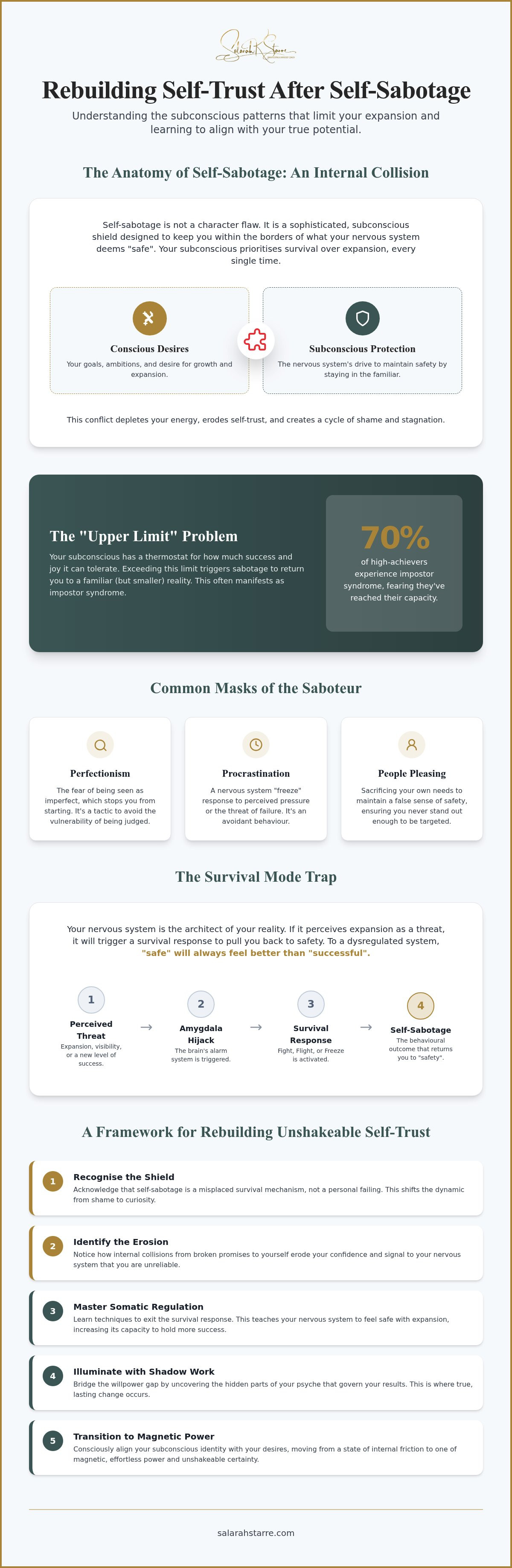
You’ve likely felt the sting of the "upper limit" problem, where 70% of high-achievers experience impostor syndrome, fearing they’ve reached the edge of their capacity. This article promises to help you dismantle those hidden barriers, recalibrate your energetic frequency, and forge a sense of unshakeable confidence. We will explore how to align your subconscious architecture with your conscious desires, moving you from a state of friction to one of magnetic, effortless power.
Key Takeaways
- Recognise that self-sabotage is a misplaced survival mechanism; it's a subconscious shield designed to keep you within a known, safe perimeter.
- Identify how internal collisions from broken promises erode your confidence and learn the primary steps for rebuilding self-trust after self-sabotage.
- Master somatic regulation to exit the survival response, ensuring your nervous system feels safe with expansion rather than retreating to stagnation.
- Bridge the willpower gap by using shadow work to illuminate the hidden parts of your psyche that govern your results, even whilst your conscious mind tries to move forward.
- Transition from survival mode to magnetic power by aligning your subconscious identity with your conscious desires for unshakeable internal certainty.
The Anatomy of Self-Sabotage: Why Your Subconscious Breaks Its Own Promises
Self-sabotage is not a lack of discipline. It is not a character flaw. It is a sophisticated, subconscious shield designed to keep you within the borders of what your mind deems "safe". Your subconscious prioritises survival over expansion every single time. When you attempt to step into a higher version of yourself, your internal security system perceives the unknown as a threat. This creates an internal collision. You want to grow, but your psyche wants to hide. Understanding The Anatomy of Self-Sabotage is the first step toward reclaiming your power. You aren't broken; your internal guard is simply working overtime to protect a version of you that no longer exists.
Every broken promise to yourself is a microscopic fracture in your foundation. When you commit to a goal and then retreat, you signal to your nervous system that you are unreliable. This erosion of confidence makes rebuilding self-trust after self-sabotage feel like an intense, uphill battle. You begin to fear your own ambition because you've conditioned yourself to expect the fall. This is often driven by the "Upper Limit Problem". Your subconscious has a thermostat for how much joy, success, and visibility it can tolerate. Once you exceed that limit, it triggers a "re-set" through sabotage to bring you back to a familiar, albeit smaller, reality.
Common Masks of the Saboteur
The saboteur rarely presents itself as a villain. It wears the mask of logic, caution, or virtue. Perfectionism is one of its most effective disguises; it's the fear of being seen as imperfect, which stops you from ever starting. You don't launch because it isn't "ready", but really, you're just avoiding the vulnerability of being judged. Procrastination is another; it's a nervous system response to perceived pressure. Your body enters a freeze state to avoid the perceived threat of failure. People pleasing is the third; you sacrifice your own needs to maintain a false sense of safety amongst others, ensuring you never stand out enough to be targeted. These behaviours are not mistakes; they are tactical retreats.
The Cost of the Internal Collision
The true price of this conflict is the depletion of your magnetism. When you live in a state of internal war, your energetic frequency drops. You become heavy, hesitant, and hidden. The cycle of shame that follows a sabotaging event only reinforces the pattern; it tells you that you aren't capable, which makes the next sabotage even more likely. This shame acts as a glue, sticking you to the very survival mode you are trying to escape. Rebuilding self-trust after self-sabotage requires you to stop the self-flagellation and start the recalibration. Self-sabotage is a protective subconscious response rather than a lack of discipline.
The Survival Mode Trap: How Your Nervous System Dictates Your Self-Trust
Your nervous system is the silent architect of your reality. It doesn't care about your five-year plan. It doesn't care about your revenue goals. It cares about one thing: keeping you alive. When you are stuck in a cycle of self-sabotage, your amygdala has essentially hijacked your conscious intentions. It perceives the expansion required for success as a threat to your safety. To a dysregulated system, "safe" will always feel better than "successful". If your body associates high performance with burnout or visibility with attack, it will trigger a fight, flight, or freeze response to pull you back. This biological imperative is the primary hurdle in rebuilding self-trust after self-sabotage.
We often talk about mindset, but your mindset is a downstream effect of your physiology. If your nervous system is trapped in a state of contraction, no amount of positive thinking will shift the needle. You must address your Nervous System Capacity. This is the volume of energy, success, and joy your body can actually contain without short-circuiting. If you try to force a high-frequency life into a low-capacity system, the system will blow a fuse. That "blown fuse" is the sabotage. It is a desperate attempt by your biology to return to a baseline it understands.
Living in Survival Mode
Recognising when you are operating from survival mode is crucial for your evolution. It manifests as chronic hyper-vigilance, a persistent feeling of exhaustion, and the nagging sensation of "waiting for the other shoe to drop". You are constantly scanning for threats, even amongst your wins. This state of physiological threat is the antithesis of creation. You simply cannot manifest abundance from a place of fear. Understanding the nervous system and manifestation is vital; your body must feel safe enough to receive what your mind is asking for. If you're ready to stop the struggle, one to one coaching can help you navigate this transition by addressing the root of the threat response.
Regulating for Trust
To bridge the gap between where you are and where you want to be, you must learn to overcome self-defeating behavior by working with your biology, not against it. This involves "toning" the vagus nerve to signal to your brain that you are secure. When a sabotage "spike" occurs, somatic practices such as deep diaphragmatic breathing, grounding, or cold-water exposure can pull you out of the survival response. These techniques allow you to stay present whilst your capacity expands. Self-trust is a physiological state of safety, not just a mental concept. It is the visceral knowing that you can handle the energy of your own expansion. By prioritising regulation, you create the internal foundation necessary for rebuilding self-trust after self-sabotage.
Shadow Work vs. Positive Thinking: Why Willpower Cannot Fix Subconscious Patterns
Willpower is a finite resource. It is a flickering candle in a hurricane. Your conscious mind accounts for a mere 5% of your cognitive processing, leaving the remaining 95% to the vast, unseen machinery of the subconscious. When you attempt to force change through sheer grit, you are fighting a losing battle against your own internal programming. This is the Willpower Gap. It is the reason why your resolutions crumble and why you find yourself repeating the same destructive cycles despite your best intentions. To succeed in rebuilding self-trust after self-sabotage, you must stop trying to out-will your biology and start addressing the architecture of your psyche.
Shadow work is the surgical, high-level approach to this recalibration. It is the process of illuminating, integrating, and transcending the hidden parts of yourself that you have suppressed, denied, or disowned. These shadow aspects are the true drivers of your sabotage. Whilst positive thinking attempts to paint over the cracks, shadow work digs into the foundation. It demands a level of radical honesty that most are unwilling to face. It is not about "fixing" yourself; it is about reclaiming the power you’ve locked away in the dark. This is how you move from surface-level management to profound structural change.
The Illusion of Positive Thinking
Positive affirmations often backfire. If you repeat "I am worthy" whilst your subconscious holds a shadow belief that you are fundamentally flawed, you create an internal collision. This friction generates more anxiety, more resistance, and more self-doubt. It is a form of spiritual bypass, an attempt to leap into high-vibe states without doing the necessary work in the trenches. "Faking it until you make it" only deepens the divide between your persona and your truth. For a more potent method, explore shadow work for self-sabotage as your primary tool for lasting alignment.
Integrating the Shadow
Every sabotaging behaviour has a hidden gain. You stay small to avoid criticism. You procrastinate to avoid the pressure of high expectations. You push people away to prevent the pain of rejection. By identifying these gains, you stop being a victim of your patterns and start becoming their master. Integrating the shadow allows you to reclaim the energy trapped in these suppressed emotions. You stop the internal war. You move into a state of unshakeable certainty. This radical honesty is the only path to rebuilding self-trust after self-sabotage, transforming your deepest fears into your greatest source of magnetic power.
A Step-by-Step Framework for Rebuilding Unshakeable Self-Trust
The process of rebuilding self-trust after self-sabotage is a methodical reclamation of your internal authority. It is not about making grand, sweeping gestures that your nervous system will ultimately reject. Instead, it requires a surgical approach to your daily habits and internal dialogue. You must move from a state of reactive survival to one of intentional creation. This framework is designed to bypass the conscious mind's resistance and speak directly to the subconscious structures that hold your patterns in place. Witness. Breathe. Align.
- Step 1: Radical Awareness. You cannot shift what you do not see. Begin by spotting the sabotage whilst it is happening. Observe the urge to procrastinate, the impulse to please, or the desire to hide without judgement.
- Step 2: Somatic Regulation. When the sabotage "spike" hits, your body is in a stress response. Use deep, rhythmic breathing to signal safety to your amygdala. You must exit survival mode before you can make a powerful choice.
- Step 3: Subconscious Enquiry. Turn toward the shadow. Ask: "What are you trying to protect me from?" This dialogue shifts you from a victim of your behaviour to a conscious observer.
- Step 4: Micro-Integrity. Start making tiny, non-negotiable promises to yourself. These are "minimum viable promises" that are too small to fail.
- Step 5: Energetic Recalibration. Align your frequency with the version of you that already possesses the result. Feel the certainty, the ease, and the power of that reality now.
The Power of Micro-Integrity
Big, audacious goals often trigger a massive survival response because the subconscious perceives the change as too risky. To counter this, you must master the art of micro-integrity. If you promise to meditate for an hour and fail, you reinforce the story that you can't be trusted. If you promise to take three conscious breaths and succeed, you begin to rewire the brain's reward system. Micro-integrity acts as a bridge between survival and power, allowing you to build the "trust muscle" without alerting your internal security system. Celebrate these microscopic wins; they are the foundation of your new, unshakeable identity.
Breaking Relationship Cycles
Your level of self-trust dictates the boundaries you set and the partners you attract. If you don't trust yourself, you'll likely struggle to trust others, often leading to breaking toxic relationship patterns through deep subconscious work. Reclaiming your power in love requires a "Non-Negotiable" list—a set of standards that you refuse to compromise on, no matter the external pressure. When you honour these boundaries, you signal to the universe that your self-trust is no longer for sale. If you're ready to dismantle these cycles for good, explore my Deep Healing Programs & Retreats to accelerate your transformation.
Magnetic Recalibration: Shifting From Sabotage to Authentic Power
The journey of rebuilding self-trust after self-sabotage concludes with The Magnetic Recalibration. This is the definitive process of aligning your subconscious identity with your conscious desires. It is a structural shift. It is a visceral realignment. It is a total transformation. When you move out of the defensive posture of Survival Mode, you enter Magnetic Mode. In this state, you no longer negotiate with your potential. You live with unshakeable certainty. You move with precision. You act with authority. This isn't about hope; it's about the surgical removal of the internal barriers that once kept you small.
Maintaining this state during high-stakes situations requires a mastery of the somatic and subconscious tools we've discussed. When the pressure mounts, the ego often tries to revert to old, safe patterns of sabotage to protect the status quo. High-level mentorship becomes essential here. Your subconscious is designed to hide its own tracks; you cannot identify your own blind spots whilst you are inside them. A mentor acts as a strategic ally, illuminating the hidden debris and ensuring your energetic frequency remains tuned to your highest goals. This external perspective is the catalyst that prevents a temporary setback from becoming a permanent retreat.
Reclaiming Your Personal Power
Imagine a life where you no longer fear your own success. When you stop bracing for the fall, you finally have the capacity to enjoy the climb. The ripple effect of this internal shift is profound. Your career accelerates because you stop second-guessing your value. Your health improves because you are no longer flooded with survival-based cortisol. Your relationships flourish because you no longer project your internal war onto those around you. Move beyond the exhausting cycle of "trying" to change. Step into the power of "being" the version of you who is already there. This is the essence of rebuilding self-trust after self-sabotage; it is the return to your natural state of abundance.
Next Steps for Deep Transformation
Information without implementation is just entertainment. If you are ready to begin the visceral work of reprogramming your psyche, join a manifestation workshop UK. These sessions provide the energetic environment needed to initiate the shift. For those demanding rapid, bespoke results, my one to one coaching offers a direct path to subconscious recalibration. We will dismantle the survival mechanisms, silence the saboteur, and ignite your magnetic power. The strength of a person who truly trusts themselves is unshakeable. You are the architect. You are the catalyst. You are the power.
Step Into Your Magnetic Power
You’ve spent enough time at war with your own potential. True transformation doesn't happen through grit; it happens through the surgical alignment of your nervous system, your subconscious beliefs, and your internal authority. By shifting from survival mode to a regulated state of safety, you've learned that rebuilding self-trust after self-sabotage is a process of reclaiming your power. You now have the tools to spot the saboteur, regulate the spike, and honour the micro-integrity that builds unshakeable confidence.
As a bestselling author with nearly twenty years of expertise in subconscious reprogramming, I specialise in the shadow work and energetic alignment required to dismantle these hidden barriers. You don't have to navigate this internal collision alone. It's time to move beyond the "upper limit" and step into a life of magnetic certainty. Ready to break the cycle? Explore The Magnetic Recalibration and reclaim your power today.
The version of you that already has the result is waiting for you to catch up. Stop trying. Start being. Your expansion is non-negotiable.
Frequently Asked Questions
What is the root cause of self-sabotage in high achievers?
The root cause is a misplaced survival strategy often triggered by the "Upper Limit Problem". Your subconscious associates high-level success with a perceived threat to your safety, privacy, or social connection. It triggers sabotage to pull you back to a familiar, predictable baseline. You aren't lacking discipline; your internal security system is simply over-protecting you from an expansion it doesn't yet feel safe to hold.
Can I really rebuild self-trust after years of breaking promises to myself?
Yes, rebuilding self-trust after self-sabotage is entirely possible through the practice of micro-integrity. You must stop making grand, audacious promises that your nervous system rejects. Instead, commit to tiny, non-negotiable actions that are too small to fail. These microscopic wins rewire your reward system. They prove to your subconscious that you are reliable, consistent, and safe, slowly repairing the fractures in your internal foundation.
How do I know if I'm in survival mode or just stressed?
Stress is a temporary reaction to external pressure, whilst survival mode is a chronic physiological state of hyper-vigilance. If you feel constantly exhausted, find yourself scanning for threats amongst your wins, or live with the nagging feeling that the "other shoe is about to drop", you are in survival mode. Your nervous system is trapped in a loop of fight, flight, or freeze, prioritising safety over growth.
Why does shadow work help with self-sabotage more than positive thinking?
Positive thinking only addresses the 5% of your conscious mind, whereas shadow work targets the 95% that actually drives your behaviour. Affirmations often backfire if they clash with a hidden shadow belief. Shadow work allows you to surgically identify, integrate, and transcend the suppressed parts of your psyche. It stops the internal war by addressing the root cause rather than merely painting over the cracks with temporary optimism.
What is the quickest way to stop a sabotaging pattern in the moment?
The quickest way is immediate somatic regulation to exit the survival response. When you feel the impulse to sabotage, use deep, rhythmic diaphragmatic breathing to signal safety to your amygdala. This physiological shift pulls you out of a "freeze" or "flight" state. By calming your nervous system, you create the necessary space to make a conscious choice rather than reacting from a place of primal fear.
How long does it take to reprogram the subconscious mind for trust?
Reprogramming the subconscious is a surgical process that varies by individual, though research indicates significant shifts often occur within three to twelve months. Consistency is your greatest ally. By prioritising daily regulation and micro-integrity, you can see measurable improvements in your internal certainty within six months. This isn't a quick fix; it is a profound structural realignment that demands depth, dedication, and unshakeable focus.
Is self-sabotage a sign of a mental health condition?
Self-sabotage is not a clinical mental health condition; it is a learned survival mechanism or a misplaced protective strategy. It often stems from childhood experiences where success or visibility was associated with instability or danger. Whilst it can coexist with anxiety or depression, it is primarily a subconscious habit designed to maintain the status quo. Reclaiming your power requires reprogramming these patterns rather than seeking a clinical diagnosis.
How does nervous system regulation affect my manifestation ability?
Your nervous system acts as the energetic filter for your reality. You simply cannot manifest abundance whilst your body is in a state of physiological threat. Regulation expands your capacity to receive, hold, and sustain success. When your system feels safe, your frequency aligns with your desires. This is why rebuilding self-trust after self-sabotage is the essential foundation for any true manifestation work.