How to Stop Overthinking and Self-Doubt: A Subconscious Recalibration Checklist

What if your relentless mental loops aren't actually about the decision at hand? Your struggle with how to stop overthinking and self-doubt is not a character defect; it is a sophisticated survival behaviour. You're likely exhausted by the constant analysis, the missed opportunities, and that persistent physical tension that never seems to leave. You've been told to just "think positive," but you know that's too shallow for the depth of your soul. You're ready for something deeper, something visceral, and something that actually shifts your internal centre.
It's time to stop managing symptoms and start realigning your subconscious architecture. This article will show you how to dismantle the survival mechanisms driving your hesitation so you can reclaim an unshakeable sense of self-trust. We'll explore a precise, surgical approach to recalibrating your nervous system and silencing the mental noise. You'll discover a subconscious recalibration checklist designed to ignite decisive action, foster deep-seated confidence, and cultivate a magnetism that doesn't require external validation.
Key Takeaways
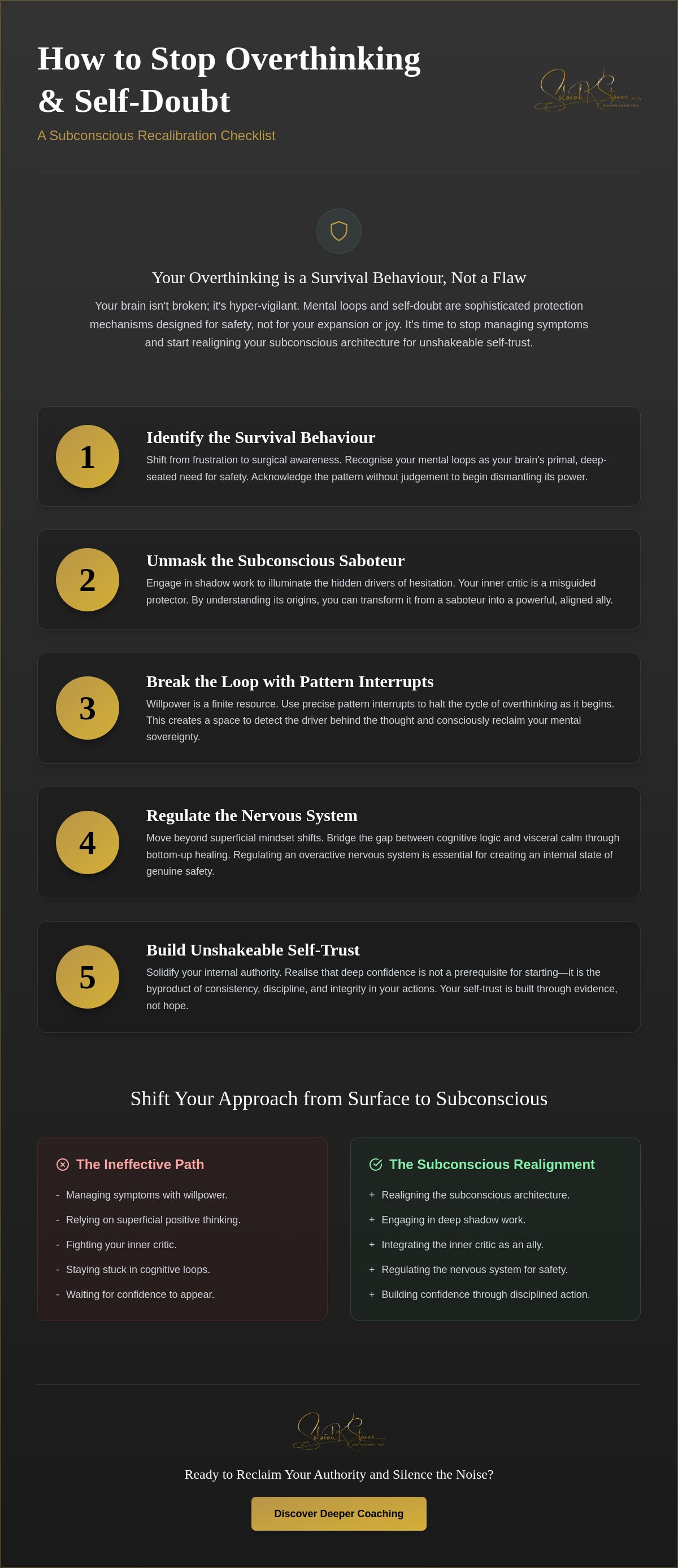
- Identify your mental loops as sophisticated survival behaviours rather than personality flaws. Shift from frustration to surgical awareness of your brain's primal need for safety.
- Unmask the hidden drivers of hesitation through shadow work. Transform your inner critic from a relentless saboteur into a powerful, aligned, and protective ally.
- Implement a precise five-step checklist on how to stop overthinking and self-doubt. Use pattern interrupts to break the loop, detect the driver, and reclaim your mental sovereignty.
- Move beyond superficial mindset shifts by regulating an overactive nervous system. Bridge the gap between cognitive logic and visceral, embodied calm through bottom-up healing.
- Solidify your internal authority by building unshakeable self-trust. Realise that confidence is a byproduct of consistency, discipline, and integrity; not a prerequisite for starting.
The Survival Trap: Why Your Brain Chooses Overthinking
Your brain isn't broken. It's hyper-vigilant. Most people searching for how to stop overthinking and self-doubt treat their racy minds like a glitch in the system. In reality, your subconscious has weaponised thought to predict, prevent, and bypass potential pain. It's a primal survival mechanism. It isn't interested in your joy, your expansion, or your fulfilment. It cares only about your safety. This biological bias creates a loop where you obsess over every variable, leading directly to Analysis paralysis. You aren't being thorough; you're being hunted by your own perceived risks.
Surface-level worry is just the tip of the iceberg. Beneath it lies a complex web of deep-seated subconscious protection patterns. These patterns operate in the dark, driving your behaviour without your conscious permission. Self-doubt isn't an accident or a personality flaw. It's a buffer. It acts as a structural barrier that prevents you from becoming too visible, too successful, or too vulnerable. If you doubt yourself, you stay small. If you stay small, you stay "safe" from the perceived judgment of the world. It’s a sophisticated, albeit exhausting, strategy to avoid the unknown.
The Illusion of Control
We often mistake the act of thinking about a problem for the act of solving it. They aren't the same. Your brain receives a subtle dopamine hit every time you "prepare" for a worst-case scenario. It feels like progress. It feels like protection. It feels like power. But it’s a hollow victory that keeps you tethered to the past. You're trying to out-think a future that hasn't happened yet. Overthinking is a subconscious attempt to control the uncontrollable.
From Survival Mode to Personal Power
Living in a state of persistent overthinking means you're trapped in survival mode. You'll recognise it by the shallow breath, the racy pulse, and the inability to rest. This state effectively hijacks your prefrontal cortex. It shuts down your capacity for innovation, decision, and leadership. It’s a state of internal collision where your desire for growth meets your fear of change. When this occurs within a team or organisation, the collective energy stagnates and progress stalls. Engaging a transformational speaker UK can provide the necessary catalyst to shift these group dynamics, moving the collective from reactive fear to proactive power. You must break the cycle, realign your focus, and reclaim your authority.
Decoding the Subconscious Saboteur
To master how to stop overthinking and self-doubt, you must first understand that your inner critic is not a villain. It is a sentinel. This internal voice is a misguided protector, standing guard over old wounds and perceived threats. It operates from the shadows, using hesitation as a shield and second-guessing as a fortress. When you feel an internal collision between your conscious desire for growth and a paralyzing urge to retreat, you are experiencing a subconscious mismatch. Your logic wants expansion; your biology wants safety.
Positive thinking alone cannot penetrate these deep-seated energetic blocks. You cannot simply "affirm" your way out of a survival response. True shifts require shadow work. This is the process of looking beneath the surface to identify the hidden drivers of your behaviour. By illuminating the parts of yourself that you have suppressed or judged, you begin to integrate them. This integration dissolves the friction. It replaces the racy, anxious noise of the saboteur with the steady, grounded resonance of your authentic authority.
Identifying the Root of Self-Doubt
Your adult overthinking is rarely about your current circumstances. It is often a repetition of childhood programming. These early blueprints dictate what feels safe and what feels dangerous. If you were taught that visibility leads to judgment, your subconscious will generate self-doubt to keep you hidden. This is known as secondary gain. You stay stuck, but you stay "safe." To break this, you must be willing to confront a provocative question: What am I keeping myself safe from by not deciding? Identifying the payoff of your paralysis is the first step toward dismantling it. If you find yourself stuck in these patterns, exploring one to one Coaching can provide the surgical precision needed to untangle these roots.
Subconscious Reprogramming vs. Willpower
Willpower is a finite resource. It is a cognitive tool that inevitably fails during moments of high stress or exhaustion. Relying on it to suppress overthinking is like trying to hold a beach ball underwater; eventually, it will snap back to the surface. Whilst clinical strategies to stop the cycle of rumination offer valuable cognitive bridges, they often stop at the level of the mind.
Recalibrating the subconscious requires a total identity shift. You must teach your nervous system that success, visibility, and decisive action are not threats to your survival. You are shifting from a state of reaction to a state of creation. True transformation occurs when the subconscious no longer perceives your success as a threat. When your internal architecture is aligned, the need for overthinking simply evaporates.
The Recalibration Checklist: 5 Steps to Silence Self-Doubt
Stop waiting for a "perfect" moment of clarity. Clarity is a consequence of movement, not a prerequisite for it. To master how to stop overthinking and self-doubt, you need a precise, repeatable protocol that bypasses the ego's noise and speaks directly to your nervous system. This checklist is your blueprint for realignment. It moves you from the racy, static-filled state of analysis paralysis into a frequency of grounded power. You aren't just changing your mind; you're reorganising your energetic signature.
Step 1 & 2: Breaking the Loop
First, you must create a gap. Use "The Pause." This is a physical pattern interrupt. Stand up. Shake your limbs. Change your environment. This break in the circuit prevents the subconscious from spiralling deeper into the familiar groove of worry. Once the loop is broken, you must detect the driver. Ask yourself: Is this thought an objective fact, or is it a protection story? Most of what you perceive as "rational analysis" is actually strategies to stop overthinking that your brain has misapplied to keep you safe. Label the racy thoughts as "subconscious noise." This simple act of categorisation strips the fear of its authority and grounds you in the present moment whilst the mind attempts to wander.
Step 3, 4 & 5: Integration and Action
Step three involves dissecting the shadow. Acknowledge the part of you that feels unsafe moving forward. Don't fight it. Integrate it. Give that hyper-vigilant energy a new job: use it to scan for opportunities instead of threats. Before you act, you must regulate the system. Use somatic tools like box breathing or cold water exposure to pull yourself out of the survival response. This is where the deep work happens. Many find that immersive experiences, such as Deep Healing Programs & Retreats, provide the necessary environment to fully automate this state of regulation.
Finally, execute with authority through micro-decisions. Don't try to solve the next ten years. Solve the next ten minutes. These small wins rebuild the muscle of self-trust, proving to your subconscious that you are safe in your power. Micro-decisions are the secret to overcoming massive analysis paralysis because they require very little "safety" from the brain to initiate. Each small choice acts as a structural realignment, shifting you from a spectator of your life to the sovereign commander of your destiny.
Beyond Mindset: Regulating the Overactive Nervous System
Mindset work is a scalpel; somatic regulation is the foundation. If you are searching for how to stop overthinking and self-doubt, you must understand that the racy, buzzing static in your skull isn't a lack of discipline. It is a physiological symptom. When your nervous system is stuck in a state of high alert, your brain is forced to scan for threats. It creates problems to solve. It invents scenarios to survive. It keeps you trapped in a loop of analysis to avoid a perceived collision with pain. You cannot think your way out of a feeling that is trapped in your tissues.
Traditional personal development often focuses on "top-down" healing, attempting to use logic to override biology. It's inefficient. It's exhausting. It's futile. True energetic alignment occurs when you move toward "bottom-up" regulation. This means teaching your body that it is safe before you ask your mind to be quiet. Hustle culture demands that you ignore your body. It tells you to push through, override your instincts, and sacrifice your peace for productivity. This approach only deepens the dysregulation, ensuring that your self-doubt remains a permanent resident in your psyche.
Somatic Tools for Instant Calm
To silence the noise, you must speak the language of the body. Simple vagus nerve exercises, such as extended exhales or gentle humming, send an immediate signal of safety to the brainstem. This isn't "soft" wellness. It is a surgical strike against the survival response. When you cultivate a weighted presence, you stop floating in the racy clouds of "what if" and anchor yourself in the power of "what is." Decisions made from this grounded state are clean, sharp, and authoritative. For many high-performers, an energetic alignment workshop UK is the missing link that finally bridges the gap between cognitive understanding and visceral embodiment.
Building a "Safety Container" for Growth
Your capacity for success is limited by your capacity for safety. If your nervous system perceives visibility or high-level achievement as a threat, it will use self-doubt as an emergency brake. This is your "upper limit" in action. To expand, you must build a safety container that can hold your new identity without triggering a shutdown. Overthinking is often the mind trying to "process" more energy than the body feels safe holding. By regulating your system, you increase your voltage. You become a match for the life you desire, rather than a prisoner of the fears you've outgrown. If you're ready to stop the mental gymnastics and start leading with unshakeable certainty, explore our Manifestation Workshops to begin your recalibration.
Reclaiming Your Authority: The Path to Unshakeable Self-Trust
Self-trust is the ultimate antidote to the racy, exhausting cycle of analysis. It is the final piece of the puzzle for those mastering how to stop overthinking and self-doubt. Most people wait to feel confident before they act. This is a fundamental error. Confidence is a byproduct; self-trust is the foundation. You don't build it through grand gestures or sudden epiphanies. You build it through the relentless, surgical consistency of keeping promises to yourself. It is the quiet, internal certainty that you can handle whatever outcome your decisions create.
To move beyond the survival mechanisms we have discussed, you must undergo a profound identity shift. This is where The Magnetic Recalibration becomes essential. It is not a temporary fix or a superficial mindset shift. It is a definitive method for restructuring your internal architecture. You are moving from a state of internal collision to a state of streamlined power. When your subconscious no longer perceives your authority as a threat, the need for overthinking simply dissolves. You stop being a seeker of external answers and start being the sovereign authority of your own life.
The Identity Shift
True transformation requires you to shed the label of "overthinker." That story no longer serves you. You are shifting into the identity of a decisive leader who occasionally has thoughts, rather than a person defined by their mental noise. Subconscious reprogramming changes your default setting. Instead of defaulting to doubt, you default to certainty. This shift is accelerated when you intentionally place yourself in high-frequency environments. Surround yourself with mentors who demand depth. Seek out spaces that challenge your smallness. Break, shift, and realign your reality until certainty becomes your natural state of being.
Taking the Next Step
The journey from survival mode to magnetic alignment is a path of reclamation. You have learned to identify the survival trap, decode the saboteur, and regulate your nervous system. You now possess the checklist to silence the noise. But information alone is not integration. To fully embody this new frequency, you must be willing to go deeper. Whether through One to one Coaching or the immersive power of our Deep Healing Programs & Retreats, the goal remains the same: total alignment.
Stop managing the symptoms of your hesitation. Stop negotiating with your fear. The time for "thinking about it" has passed. It is time to heal the source, recalibrate your system, and step into the unshakeable self-trust that is your birthright. Decide, act, and expand. Your future self is waiting for you to lead.
Master Your Internal Architecture
You now possess the blueprint to shift from mental static to sovereign clarity. You understand that your racy mind is a survival response, not a life sentence. By implementing the recalibration checklist and prioritising nervous system regulation, you have begun the surgical process of dismantling the saboteur. You're no longer wondering how to stop overthinking and self-doubt; you're actively realigning your frequency with the version of yourself that can decide, act, and expand without hesitation.
True transformation requires more than just reading; it demands visceral immersion. With nearly two decades of experience in subconscious reprogramming and a deep specialism in shadow work, Salarah K Starre facilitates the internal shifts that logic alone cannot reach. As a bestselling author and expert in nervous system regulation, she provides the grounded authority needed to anchor your new identity. It's time to stop the internal collision and start leading with unshakeable magnetism. Reclaim your power and stop the mental noise—book your One to one Coaching session with Salarah K Starre today.
Your authority is waiting. Reclaim it now.
Frequently Asked Questions
Is overthinking a symptom of anxiety or just a personality trait?
Overthinking is a hyper-vigilant survival strategy, not a fixed personality trait. It’s often a symptom of a dysregulated nervous system attempting to predict and prevent pain. Whilst it frequently presents amongst those with anxiety, it is essentially a biological bias for safety. You aren't "just an overthinker." You are currently operating in a state of high alert that requires recalibration to return to a state of calm authority.
Can I ever truly stop overthinking, or is it something I just have to manage?
You can absolutely stop the cycle of overthinking by healing the underlying subconscious drivers. Managing symptoms is a surface-level approach that leads to mental exhaustion. Real transformation happens when you address the source of the racy thoughts. By following a structured protocol on how to stop overthinking and self-doubt, you shift your internal architecture. This moves you from a state of constant analysis into a frequency of unshakeable, decisive action.
How does shadow work help with self-doubt?
Shadow work unmasks the hidden parts of your psyche that use self-doubt as a protective shield. It allows you to identify the "secondary gain" of staying stuck, such as avoiding the perceived risks of visibility or judgment. When you integrate these shadow aspects, they stop sabotaging your progress from the dark. This process transforms your inner critic into a powerful ally, aligning your subconscious fears with your conscious desires for growth.
Why do I start overthinking more when things are actually going well?
Success often triggers a survival response because your subconscious perceives significant change as a threat to your safety. This is known as an upper limit problem. When things go well, your brain scans for potential disasters to "prepare" you for a fall. It is a misguided attempt to keep you within your familiar comfort zone. Recognising this as a biological glitch allows you to regulate your system and hold more success.
What is the quickest way to stop a spiral of self-doubt in the middle of a meeting?
The fastest way to break a mental spiral is a physical pattern interrupt. Anchor your weight into your chair, press your feet firmly into the floor, and lengthen your exhale. This somatic shift signals safety to your brainstem, pulling you out of the racy "what if" loops. By grounding your physical body, you reclaim your weighted presence. This allows you to speak and decide from a place of authority rather than reactive fear.
How do I know if my doubt is "intuition" or just a subconscious block?
Intuition is a neutral, calm "knowing" that feels grounded in your centre. Doubt is a racy, anxious "noise" that usually involves fear, judgment, or repetitive loops. Intuition expands your energy; doubt contracts it. If the thought is accompanied by a racy pulse or physical tension, it’s likely a subconscious block. Learning how to stop overthinking and self-doubt involves sharpening your ability to distinguish between these two distinct internal frequencies.
Can subconscious reprogramming really change how I think in the long term?
Subconscious reprogramming creates permanent structural shifts in your internal blueprint. It moves your default setting from reactive survival to proactive creation. By realigning your identity at the root, you change the way your brain automatically processes information. This isn't about using willpower to "think better." It’s about ensuring your subconscious no longer perceives your power as a threat, allowing long-term certainty to become your natural state of being.